Laboratory

Forage laboratory via NIR and EDXRF minerals in association with CVAS (Cumberland Valley Analytical Services)

Near Infrared Reflectance spectroscopy (NIR) allows for rapid determination of multiple nutrients and characteristics of a feed or forage. It is a fast, cost effective process available for evaluation of most forage types. This determination depends mostly on the support of a chemical laboratory providing accurate robust calibrations of each component and type of feed.

Given the volume and breadth of chemistry evaluations that CVAS provides as the largest chemical laboratory of forages in the USA, their calibrations are the most robust of the market.

In addition, from September 2019, we offer mineral analysis by Energy dispersive X-ray fluorescence (EDXRF), a fast and accurate method to detect minerals on any type of feed.
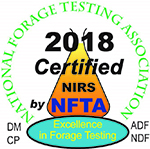
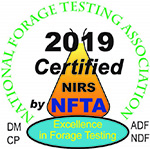
             

Type of analysis that we carry out:

NIR NUTRITION ANALYSIS AND MIXED MINERAL DETERMINATIONS

NIR 1 Analysis of forages

NIR Analysis 1 includes determination of dry matter, moisture, crude protein, protein bound to ADF, protein bound to NDF, soluble protein, ADF, NDF, lignin, starch, ethanol-soluble carbohydrates, water-soluble carbohydrates, fat, ash, calcium (Ca), phosphorus (P), magnesium (Mg), potassium (K) and pH in ensiled forage. Calculated values are provided for RFV (forage only), available protein, adjusted protein, degradable protein, NEl, NEm, NEg (NRC summative energy equations), CNS and CNF.

NIR (Plus Option)

This option provides additional value and is added on top of NIR 1. Graphical reports and our extended-range reports are produced using the Plus option. Added nutrients include: NDF digestibility at 12, 30, 120, and 240 hours, plus uNDF values, Fermentation parameters and soluble fiber in ensiled forages, Fatty acid values and amino-acid nitrogen as a percentage of total nitrogen, Starch digestibility at 7 hours, RFQ in forages

NIR 1 (Non-Forage Ingredients)

NIR 1 analysis on brewers’ dried grains, soybean hulls, beet pulp, canola meal, DDGs, soybean meal, barley, oats, and wheat.

NIR 1 (Corn Grain)

NIR 1 analysis on corn grain, with the addition of 7-hour starch digestibility and fatty acid profile.

NIR 1 (Feces)

Provides dry matter, crude protein, ADF, NDF, lignin, indigestible NDF, starch, ash, Ca, P, Mg, and K.

DANIR (Apparent Nutrient Digestibility)

Includes an NIR 1 Plus evaluation of a high-production TMR and its associated fecal matter to generate an assessment of apparent NDF and starch digestibility.

TMR Control – NIR Package

NIR analysis plus mineral profiling by XRF. This package includes dry matter, crude protein, soluble protein, ADF, NDF, protein bound to ADF, protein bound to NDF, lignin, fat, starch, sugars, ash, Ca, P, Mg, K, Na, Fe, Mn, Zn, Cu, Cl, and S. Also includes assessments of peNDF, CSPS (starch processing score), and the Penn State Particle Size Evaluation.

TMR Mixer Evaluation Package

(Set of 5 samples analyzed to assess mixer efficiency)

NIR analysis plus mineral profiling by XRF. Includes dry matter, crude protein, soluble protein, ADF, NDF, protein bound to ADF, protein bound to NDF, lignin, fat, starch, sugars, and ash by NIR; and Ca, P, Mg, K, Na, Fe, Mn, Zn, Cu, Cl, and S by XRF.

Amino-Acid Analysis

Available only for corn silage, delivered in Excel format.

Fatty-Acid Profile by NIR (Bypass fats only)

Provides fatty-acid profile results via NIR for bypass-fat supplements.

XRF NIR 1

This is the same as NIR 1, with the addition of the following minerals by XRF: Ca, P, Mg, K, Na, Fe, Mn, Zn, Cu, Cl, and S.

Mineral Determination via XRF

Mineral analysis by energy-dispersive X-ray fluorescence. Eleven macro- and trace-minerals are measured on any raw material or forage: Ca, P, Mg, K, Na, Fe, Mn, Zn, Cu, Cl, and S.

Wet-Chemistry Determinations

Grain processing score (CSPS) for corn silage. A tool to assess kernel processing by forage choppers, defining starch particle size and its expected impact on both ruminal and total-tract digestibility. Must be added to an NIR 1 analysis.

peNDF Evaluation (Forages or TMR)

Determination of physically effective NDF according to the Mertens model. Must be added to an NIR 1 analysis.

Particle-Size Evaluation (By Penn State or Z-Box)

Determines the particle-size distribution and effective fiber of various forages and TMR samples.

Micron-Scale Particle-Size (MPS)

Determines the degree of cereal grain grinding, average particle size in microns, and particle-size distribution.

Dry-Matter Oven Analysis

Dry-Matter Oven Analysis.

Muffle-Ash Analysis

Muffle-Ash Analysis.

Enzymatic Analysis of Water-Soluble Sugars

Enzymatic Analysis of Water-Soluble Sugars.

Lactic Acid and Molasses Analysis

Lactic Acid and Molasses Analysis.

Nitrate Analysis in Forages

Nitrate Analysis in Forages.

Fermentation Analysis by Gas Chromatography

Includes dry matter, lactic acid, acetic acid, propionic acid, butyric acid, iso-butyric acid, 1,2-propanediol, valeric acid, isovaleric acid, total VFA, pH, lactic-acid/VFA ratio, ammonia-equivalent crude protein (% of dry matter), and crude protein.

Fermentation Plus Analysis

Includes the standard fermentation analysis plus a breakdown of individual alcohols, acetates, and lactates.

Ruminal-Liquid Fermentation Analysis

Ruminal-Liquid Fermentation Analysis.

Complete Bedding-Sand Analysis

Includes determinations of dry matter, organic matter, and granulometry.

Aflatoxin M1 by ELISA

Aflatoxin M1 by ELISA

Aflatoxin B1 by ELISA

Aflatoxin B1 by ELISA

MILK ANALYSIS

FTIR Milk

FTIR determination based on laboratory-certified chemical calibrations for the following parameters: Fat, Total protein, True protein, Casein, Lactose, Total solids, Non-fat solids, Urea, Conductivity, pH, Freezing point, Fatty acids (De Novo, Mixed, and Preformed), Unsaturated fatty acids, Palmitic acid, Stearic acid, Oleic acid.

BLOOD BIOCHEMISTRY ANALYSIS

Ionized Calcium Analysis (Blood)

Ionized Calcium Analysis (Blood).

Hematology Analysis

Hematology Analysis.

Hematology and General Biochemistry Analysis

Hematology and General Biochemistry Analysis.

Hematology Analysis (including General Biochemistry and Critical Care)

Hematology Analysis (including General Biochemistry and Critical Care).

Hematology and Blood Smear Analysis

Hematology and Blood Smear Analysis.


FTIR Milk Laboratory

Determination of the following parameters via FTIR, with calibrations done by a certified chemistry laboratory: Fat, Protein, Casein, Lactose, Total solids, Non-fat solids, Urea, Conductivity, pH and Cryoscopic constant.

Analysis of fatty acids in milk is available under Barbano Lab calibrations from Cornell University. This allows the differentiation of fatty acids de novo, mixed, and preformed and its practical application to evaluate ruminal function and NEFA control in post-partum. 


Hematology and biochemistry laboratory

Determination on the following blood samples:

  • Complete hemogram differentiating 5 groups of white blood cells.
  • Red blood cell count, Htcto, Hemoglobin, MCV, MCH, HCMC, RDW Platelets, VPM, PCT, PDW.
  • Detection of hemoparasites.
  • Fibrinogen.
  • Biochemistry.

Downloadable material

Access to our analysis request form through the following link:

Solicitud de análisis Alpavet

CVAS Analysis

Access the information of all the analyses carried out by our company:
Alpavet SLP is a veterinary center equipped with the most innovative technology to help you getting the best profit from your farm.

We care about the welfare of your animals, for what we analyze forages in our own laboratory.

DO YOU WANT TO CONTACT US?

  • Our offices:

    C/ Velada, 4.
    45600 Talavera de la Reina (Toledo)

    +34 925 819 153

    laboratorio@alpavet.com

We use cookies on our website. Some of them are essential for the operation of the site, while others help us to improve this site and the user experience (tracking cookies). You can decide for yourself whether you want to allow cookies or not. Please note that if you reject them, you may not be able to use all the functionalities of the site.